

/ Forschung
Quantifying Strain and Its Effect on Charge Transport in Ge/Si Core/Shell Nanowires
New publication by Aswathi K. Sivan, Arianna Nigro, Riccardo Rurali, Nicolas Forrer, Aakash Shandilya, Yang Liu, Janica Böhler, Alexander Vogel, Pierre Chevalier Kwon, Artemii Efimov, Ilya Golokolenov, Gerard Gadea, Andreas Baumgartner, Dominik M. Zumbühl and Ilaria Zardo (Advanced Science 2026)
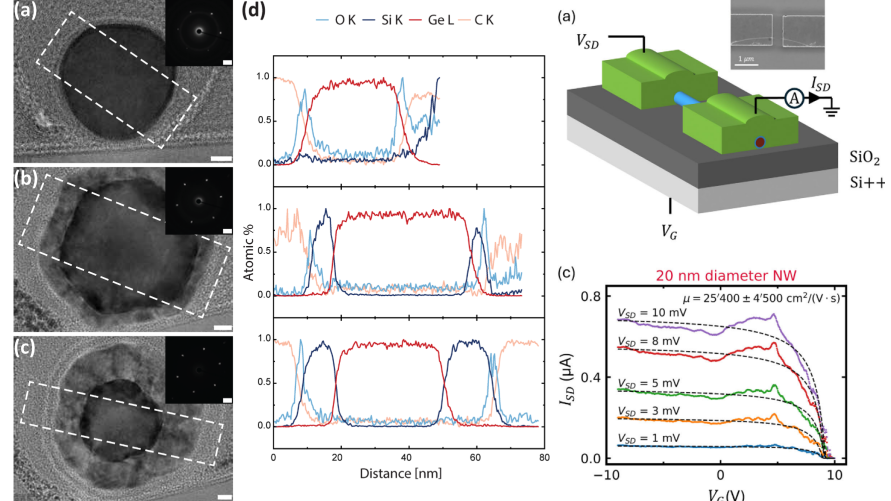
Strain engineering in semiconductor nanostructures offers a promising route to optimize electronic and optical properties for advanced quantum technologies. This study explores the relationship between core and shell thicknesses and strain distribution in Ge/Si core/shell nanowires (CS NWs), targeting their application as hosts for spin qubits. NWs were synthesized using an Au-catalysed chemical vapor deposition technique, achieving control over core and shell dimensions. High-resolution transmission electron microscopy and elemental mapping confirmed structural integrity, while Geometric Phase Analysis and Raman spectroscopy provided both qualitative and quantitative insights into strain variations driven by core and shell dimensions. Furthermore, polarization-resolved µ-Raman measurements allowed us to quantify the longitudinal and transverse phonon mode splitting as a function of strain in the Ge core. The electronic transport properties were investigated by hole mobility measurements. Finally, we observed a record high hole mobility of 25400 cm2 V−1 s−1 , underscoring the potential of our CS NW structures for the realization of high-fidelity spin qubits. Our findings highlight the critical role of geometry in strain tuning and provide valuable design guidelines for optimizing Ge/Si CS NWs in scalable quantum device architectures.